Accessibility Tools

Number 6 Cosmetic Dermatology

B. Dermal Fillers

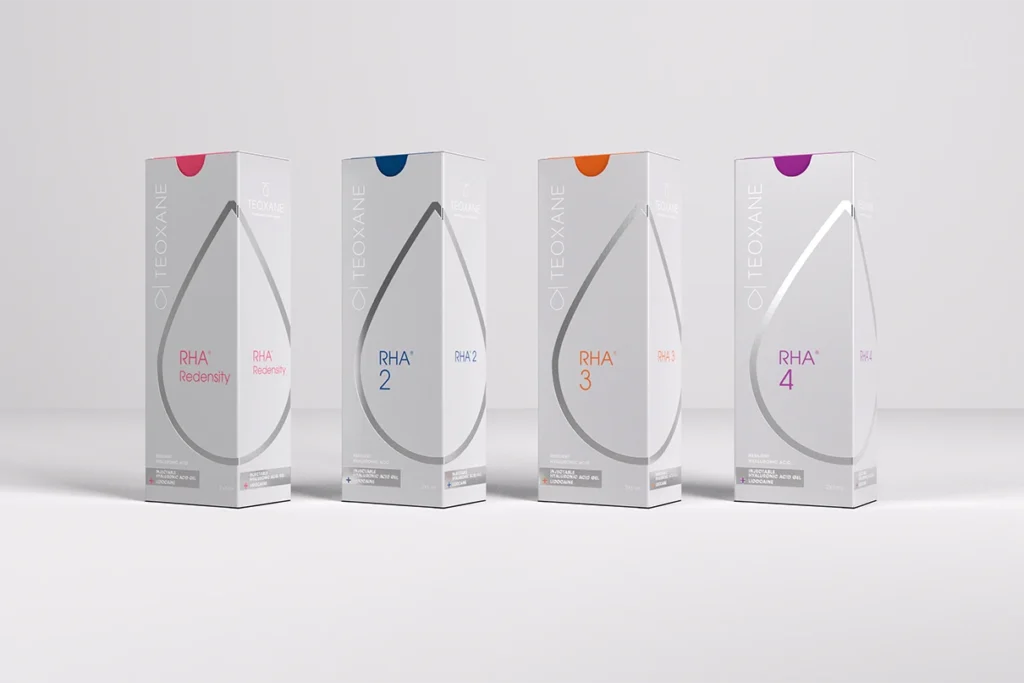
• RHA® Collection (by Teoxane Dermal Fillers)

“Resilient Hyaluronic Acid” fillers designed for natural movement)

What Is the RHA Collection?

The RHA® Collection is a family of hyaluronic acid (HA) dermal fillers designed to look natural when your face moves—smiling, talking, and expressing. Many patients choose RHA because it can provide soft, flexible support rather than a “stiff” look.

RHA fillers are commonly used to:

  • Smooth smile lines and facial folds

  • Restore volume in areas that have hollowed with time

  • Improve lip shape and hydration

  • Enhance cheek support and facial balance

  • Refine contour in select areas based on anatomy

RHA Products (Simple Breakdown)

Your injector will choose the best product based on your goals, skin thickness, and the area being treated.

RHA Redensity

  • Best for: fine lines and delicate areas, subtle smoothing and hydration

RHA 2

  • Best for: mild-to-moderate folds and soft contour refinement

RHA 3

  • Best for: deeper folds and more noticeable volume support

RHA 4

  • Best for: deeper structural support and contouring in areas needing more lift

(Product selection is individualized—our Dermatologist will explain exactly why a specific RHA filler fits your anatomy and goals.)

What to Expect During Treatment

Most RHA filler treatments are done in-office and typically take 20–45 minutes depending on the areas treated.

During your visit:
  1. We review your goals and facial anatomy

  2. The skin is cleansed

  3. Numbing is used as needed (topical numbing and/or numbing within the filler)

  4. Filler is placed with a needle or cannula, depending on the area

  5. We assess balance and symmetry in real time

You may feel pressure or a brief pinch—most patients tolerate it very well.

When Will I See Results? How Long Does It Last?

  • You’ll see improvement right away

  • Mild swelling can temporarily affect the final look for a few days

  • Results often settle in 1–2 weeks

Longevity depends on the product, area, and your metabolism. Many patients maintain results for several months to over a year in some areas, with periodic maintenance.

Pre-Op Instructions (Before RHA Fillers)

7–10 days before (to reduce bruising, if medically safe)
  • If you can, avoid aspirin and NSAIDs (ibuprofen/Advil®, naproxen/Aleve®) and certain supplements that may increase bruising (example: fish oil).

⚠️ Do not stop prescription blood thinners unless your prescribing clinician instructs you.

48 hours before
  • Avoid alcohol if possible (can increase bruising)

Tell us before treatment if you:
  • Are pregnant or breastfeeding

  • Have a history of severe allergies

  • Have an autoimmune condition or are immunosuppressed

  • Have had prior filler complications

  • Have an active skin infection, cold sore, or dental infection

  • Have a planned dental procedure soon (timing matters for some patients)

If treating the lips
  • If you get cold sores, tell us—preventive medication may be recommended.

Post-Op Instructions (After RHA Fillers)

First 24–48 hours
  • Expect mild swelling, tenderness, and possible bruising

  • Avoid strenuous exercise the day of treatment

  • Avoid saunas, hot yoga, and intense heat for 24–48 hours

  • Avoid alcohol for 24 hours if you bruise easily

  • Don’t massage the area unless your provider specifically tells you to

Makeup & skincare
  • You may apply makeup the next day (unless instructed otherwise)

  • Use gentle skincare; avoid harsh exfoliants for a few days

What’s normal
  • Mild swelling (especially lips)

  • Small bruises

  • Temporary lumpiness that often softens as swelling resolves

Call us right away if you develop:

These symptoms are uncommon but important

  • Increasing, severe pain

  • Skin that turns white, gray, or dusky, or shows a net-like dark pattern

  • Blistering, worsening redness, or skin breakdown

  • Vision changes, severe headache, or trouble speaking
    (These can be signs of a rare but serious complication and need urgent evaluation.)

Frequently Ashked Questions

What is RHA filler made of?

RHA is a hyaluronic acid (HA) filler. HA is a substance your body naturally has in skin to support hydration and volume.

RHA is often chosen for its soft, flexible support, aiming for a natural look during facial movement.

Our approach is natural results. We use careful dosing, anatomy-based placement, and can build gradually over time.

Most patients feel mild pinches and pressure. Numbing is commonly used, and many RHA products include lidocaine for comfort.

It depends on the product and area treated. Many patients enjoy results for months, sometimes longer, with maintenance as needed.

Temporary:

    • Swelling
    • Bruising
    • Tenderness
    • Small bumps at injection sites

These usually improve within a few days to 1–2 weeks.

Many HA fillers can be dissolved with an enzyme if needed. Our provider will explain when this is appropriate.

You may need to delay treatment if you are pregnant/breastfeeding, have an active infection (including cold sores/dental infection), or have certain medical conditions—your provider will review this with you.

Often, yes. Many patients combine neuromodulators and fillers for a balanced result. Your provider will recommend safe timing.